Organization, multi-level lists, and the numbers of editing

Hello dear readers.

Shall I express my sincere apologies for posting nothing but writing prompts for the last number of weeks? I shan’t, for I was deep within a story that demanded every moment of focus and creativity, and I happily neglected this blog. The Nereid is the story that emerged from the rough, disorganized, hopelessly bland mass of words I squished out of my mind from NaNoWriMo 2013. In all honesty, I had intended to pick it up again in January… but when I read it through I could not mentally traverse the leagues of work that remained to be done to salvage it.

Then, about a month ago, something clicked. And then something else clicked. Then things were clicking all over the place, like being surrounded by people cracking their knuckles (except, you know, in a pleasant and productive kind of way…), and I was able to move forward on the project.

The greatest issue I was having with my story was how it would be told through time. My draft was a hodge-podge of different techniques.

Inspired by my new job, which at times requires me to format hundred-page, multi-level documents, I did a timeline of my story – from the beginning of time until a generation past its “conclusion” – and assigned each level of the story a number.

For example (not actually the plot of The Nereid):

Part 1: Pre-history of the protagonist
Timeline: 2002-2027
Section 1.1: Protagonist has an accident-prone childhood
Chapter 1.1.1: Protagonist falls down the stairs
Chapter 1.1.2: Protagonist gets hit by a car
Chapter 1.1.3: Protagonist gets hit by a meteor
Section 1.2: Protagonist has a period of incredibly graceful teenage years
Chapter 1.2.1: Protagonist is forced to take dance lessons in high school gym class, and has natural talent
Chapter 1.2.2: Protagonist auditions for a reality dance show
Part 2:  Main body of the story
Timeline: 2027-2034

When I created a timeline for my story, I listed the general plot points that coordinated with each Part, Section, and Chapter in increasing detail. Then, where applicable, I pasted any corresponding parts of my NaNoWriMo draft in the appropriate chapter.

This was an incredibly useful process that I’ve never used before. This multi-level timeline allowed me to see the progression of events from the first moment to the last, assess where my plot was fuzzy or inconsistent, see the places in the story where I have opportunities for character and plot development, and – perhaps most importantly – get a good sense of how much work there still is to do. But my favourite thing about working in these numbered portions is how simple it is to manage my master file. Believe me. It’s a dream.

Until next time, readers.
Enthuse your muse with this writing prompt

Let the following random sentence chosen from a book on my bookshelf inspire you. Don’t think just write.

“Our voices, curving slowly around the woods, again, again swung back on silence.”
The Grass Harp, Truman Capote

Innovation and Penguin PR: #TwitterFiction

Good morning dear readers.

How has the writing been going? Are the prompts helping? The quote from Emma led me to a  story of two upper-class girls in modern New York, but told as if they lived 200 years ago. Think “Gossip Girl” as narrated by Jane Austen. Really fun to write. I’d love to hear about where the prompts have taken you so far.

In other news:

Tomorrow is the beginning of Twitter Fiction Fest – a five-day online festival exploring the question, “Can one use Twitter to tell a story?”

Penguin Random House is the figurative host of this fiction party, having selected several Twitter authors to showcase . The neato thing about this charming PR gambit is the innovation in storytelling. It’s more than just writing in 140 character chunks; the chosen authors have employed creative techniques to take full advantage of the specific medium to which they’re bound.

Whether it’s linking photo- and video-sharing sites to their feeds to create a vivid sensory experience, or setting up feeds under the names of multiple characters to tell the story from several viewpoints at once, #TwitterFiction challenges the notion of what it means to be an author, and proves once again that it’s quality and not quantity that counts.

Follow @twfictionfest to indulge in the experience and use #TwitterFest to participate yourself. For good measure, also follow @americanpublish, @randomhouse, and @penguinusa. Oh, and me: @sarahelund.

S.E. Lund

Unplugged.

A Facebook friend of mine (our relationship used to be face-to-face but now exists purely through the evil genius of Mark Zuckerberg) is also a hobby writer. He suffers, like I do, from follow-through issues stemming from habitual procrastination and a willingness to be distracted. I figure he’s talented. Years ago he promised that I could read something of his and shortly after our friendship dissolved… perhaps the pressure of my possibly judgemental review of whatever he was planning to let me read contributed to that. But I’m getting off topic. The point is he’s funny and creative and one of the rare people whose Facebook statuses are very frequent and completely personal, but somehow entertaining and engaging.

(To me, the worst Facebook offenders aren’t the vapid daily selfie posters, or the people incapable of spelling any words correctly, or even those glorious few who have uncomfortably personal conversations and arguments out there for the world to see – my dark side finds these last examples a certain kind of wonderful. What I can’t stand on social media is people being BORING: “Just got a grilled cheese. Yum!” “Ugh. More snow.” “Watching hockey with the fam. #blessed #goteam #hashtagsonfacebook.”)

This friend’s ability to post about his unextraordinary life is a friggin’ miracle. I look forward to reading what he has to say in three sentence tidbits, and I’d love to be able to read something longer. Last week he took a break from social media and the internet as a whole. My Facebook feed suffered, but his writing flourished. In his words “An entire week offline. I haven’t thought this clearly and undistractedly (not a word) since the 90s […] this is the key to being able to write. Being unplugged for relatively extended periods.”

I’m trying to decide if I agree with this statement. For the first two weeks of NaNoWriMo, I turned off the internet while I was writing. I had a rule that I could only go online once an hour for fifteen minutes, or every thousand words, whichever came first. It worked wonders, forcing me to put (virtual) words on the (digital) page because there was nothing else to do. However, about halfway through the month, once the daily writing had started to be habit and I didn’t have to be as vigilant about avoiding distractions, the tools that the wondrous internet provided were essential. I became a devotee to the @NaNoWordSprints Twitter account, which had me competing for word counts against myself and others while throwing in optional challenges like using the word sloth or writing a birthday party scene. My personal beast to slay was the #1k30min. If completing NaNoWriMo was my primary goal, completely a #1k30min was a very close second. I managed it with a few days to go while writing a scene about a shark attack. No kidding.

I’ll say that if you’re stuck, uninspired, lazy, or procrastinating – definitely unplug from everything. Go out somewhere. Sit in a quiet space with a pen and paper and watch the world. Then write stuff down. For me, if inspiration comes from the physical world, motivation can come from the digital one. If you must be plugged in, find online outlets that will push you to write – communities, writing challenges, blogging.

(Psst: My Facebook friend doesn’t know I’ve posted about him, but I guess that’s the risk you take when you say anything online).

NaNoWriMo: so how did that go?

This may sound obvious, but I learned that it takes real effort to put 50,000 words on (digital)paper in 30 days. It also requires a general culling of all of your leisure activities – like watching Netflix or, y’know, doing laundry.

The people

The staff and volunteers at NaNoWriMo are endlessly supportive. With pep talks from notable authors sent to you twice a week, virtual write-ins to attend, and my personal favourite tool, Twitter sprints, you always feel like they’re your biggest cheering section.

The real glory of this challenge is the community aspect of it all. Writing is essentially solitary, except I always felt like I was part of something larger. The forums on NaNoWriMo.org are filled with thousands of people willing to offer support, sympathy, inspiration, or a kick in the ass at any moment of the day or night. The participants of NaNoWriMo are crazy, random people from all over the globe, but I was immediately a part of their club, their family, their in-jokes.

The process

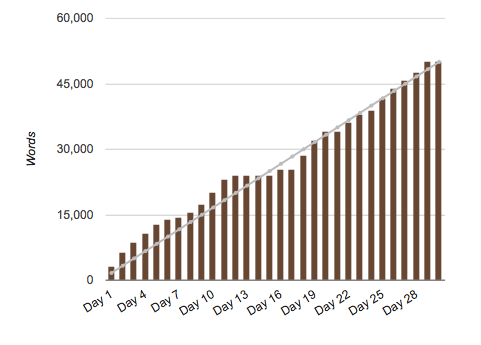
NaNoWriMo has a helpful website that calculates how you are doing as you go, and also updates a super intimidating bar graph (below) as you enter your daily word counts.

NANO bar graph 2013

As you might notice, I started strong. I had a goal to write 2000 words per day (instead of the 1667 words/day that would get me just over the finish line by November 30) and for almost the first half of the month, I did a reasonable job of meeting that goal.

Then, around day 13, the totally expected happened. I got the flu. I was an absolute mess for a good week… getting well just in time to go on the weekend away that JT and I had been planning since September.

I was so thankful I had overachieved those first two weeks. It meant that the deficit to make up was not impossible. Actually, I wrote 5000 words on the way home from our weekend away (eight hours in the car will give you that opportunity).

The second half of the month was both harder and easier. It was harder because I was focussing on other things in my personal life (I got a new job; I curl competitively; Christmas shopping had yet to be started), but easier because I had built up a momentum. I knew my characters and where I was taking them… sort of; I knew how much time I needed to put in daily to reach my goal; I knew I wasn’t likely to get sick again; I knew I had all of December to binge-watch Walking Dead and Community.

Time for the cheesy ending

I feel as of NaNoWriMo did all I hoped for and more. It demolished “writer’s block” excuses, forced me out of my comfort zone, and helped me create.

Looking forward to next year!