How 10,000 hours is a useless goal for writers

Today I read an article on Forbes.com, in which the author assesses Malcolm Gladwell’s “10,000 hours of dedicated practice” to become an expert in the frame of becoming an expert writer and finds it… well, ludicrous.

Despite the name and driving inspiration of this blog. I agree with the article.

The central argument is basically this: if you’re writing about 216 words an hour – as the author of the article does – applying Gladwell’s 10,000 hour rule, means that your first 2.16 million words (equivalent to about 21 novels of 100,000 words each) are basically, um, trash. And if you haven’t figured out how to write a good book after 21 novels… then you will probably never figure it out.

For me, however, it’s not as literal of a goal as all that. The number is aspirational, and (as the author of the article concedes), being a novelist is about more than putting words on a page. The purpose of this blog is to experience hours upon hours upon hours of writing, whether that’s through reading, writing, editing, research, discussion about words, or whatever else might fall within the blog’s loosely defined raison d’être.

Also I’m not keeping track of hours. Let’s be honest here. That sort of eye-on-the-clock attention makes everything way less fun.

Mmm… minty pt. 2


Continuing…

So, I picked out a sample of my creative writing to submit to the Story Refinery on The Story Mint.

Nostalgia

Hearing your love story.

Feeling throbs through the space. The coziness of cushions and familiar shudder-clink of radiators give way to the jagged edges of anticipation and unasked questions, to the heavy reflection on the tangible ache of a sepia view, to the manic happiness of spiritual orgasm, filling lungs and stomach and heart with air sucked from the midst of a freefall.

Wine is drunk but not savoured: an excuse for motion by bodies fettered by the tale’s thrall, while the flitting anxious emancipated imaginations predict resolutions. A story crafted for emotional emphasis, made satiating with months of hinting and hesitation. Clichés bound about, unexpected and only summoned at vocabulary’s end out of a mouth made innocent by word choice, ancient by crushing feeling.

Then reduced to sound, sigh and gesture (words have failed), the storyteller squirms and pushes at space and carpet, clutches clothes and chews chocolates, wind velocity (that is, air intake and release) conveying more than English can confine in definitions.  Accompanying onomatopoeia assist.

But maybe words have not failed but filled, and the space has only room left for deep breaths and smiling whimpers.

The storyteller begs to clear the air of thick, contemplative words by forcing another’s talk. She grasps at big questions and throws them at listeners with accuracy. The conversation turns.

(© 2011 S.E. Lund All Rights Reserved)

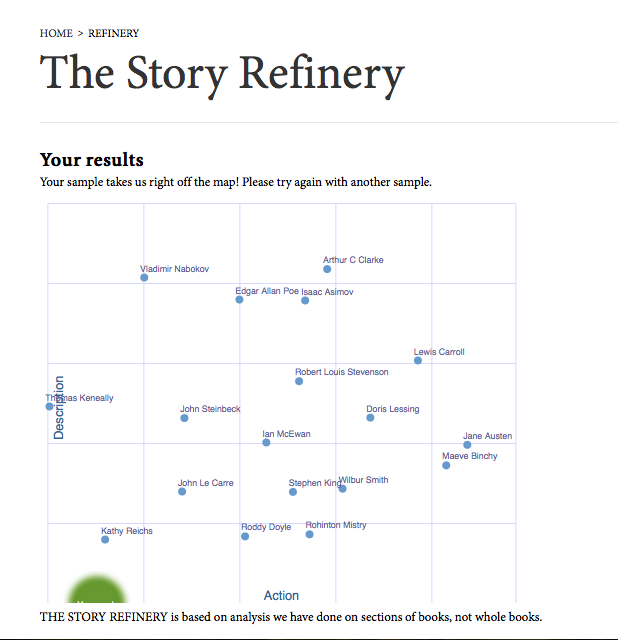
Eager for feedback, I was amused but disappointed when this screen came up:

Result #1

Apparently I am just too creative. Or, more likely, the system administrators only have a limited amount of sections of books cataloged. My second attempt was much more successful. This time, I chose something a little less poetic: the opening scene of a long story.

Chapter One

Carolyn leaned heavily against a worn oak desk. The cash register to her right was napping, wrapping itself in the thin layer of dust that covered every surface left disused for even an hour in the fusty second-hand store. The faded books in the stack on her left waited patiently to be shelved with their fellows, ignored but not neglected; Carolyn would get to them by the end of the night.

At that moment she was leafing through a photo book of lake country, her chin perched in the palm of one hand with her elbows resting on the edge of the desk. Her other hand clutched a pen as she flipped the pages with a careless snap.

The playlist that spilled through the store was an eclectic mix of Carolyn’s favourites. Punk followed banjo music which flowed into a string of motown hits. When the last notes of the final song drifted into nothingness, she was too tired to notice.

Her head wavered on her arm and her eyes drooped. “Hò-bhan, hò-bhan, Goiridh òg O, my love was not where I left him,” she hummed, oblivious to her own voice and the symbol she had started to doodle down the side of the book. A long wavy line traced its way down the length of the page in thickening black ink. A second line, separate at the top of the page, gradually overlapped and then appeared to twist itself in ever-tightening spirals around the first until the two ends connected at the bottom of the page in a crude imitation of an intricate v-shaped charm.

Carolyn’s chin teetered dangerously on its balance point, spilling long strands of her chestnut hair across her forehead. Her large hazel eyes flew open and her humming stopped.

“Damn” she said, examining her handiwork. She wasn’t nearly as irritated at herself for defacing the store’s property as for drawing that particular symbol. It seemed to spill from her pen independent of any conscious thought. She resented that the shape stuck in her mind after so many years.

She slapped the heavy covers of the book closed and grabbed the rest of the books that needed to be shelved. The desk groaned as she lifted the pile from its wizened top.

Carolyn didn’t need to think much as she distributed the books to their rightful places. The layout of the store made sense to her in a way that was second nature. Aside from the owner, she was the only one who could boast of this intuitive knowledge of Pendham’s Used Books & Oddities. Most people, customers and the few staff alike, got lost in the small store with its cache of very hidden treasures. They were used to box stores with logic and labels to lead them, and couldn’t understand the owner’s distribution of stock foremost by mood, then by author.

The store was created as a shelter and a maze. People who fought the feeling of getting lost, the notion of browsing, never felt quite comfortable among its shabby shelves.

Carolyn walked to the Regional Interest section with her drawn-in pictorial. The section, her favourite, was tucked into the back corner of the small space and had the most eclectic collection of items in the store.

Her eyes scanned the piles of mismatched travel stock in this “catch-all” section of the store and she shuffled her book, with much difficulty, into a pile of pictorials in similar condition. It was a beautiful area, she thought, running her fingers across the white-capped water on the cover of one of the display books, but then caught sight of the watch on her wrist. She ran through the to-do list in her mind. Dust, lights, lock up, home… mail, calculus, alarm, bed. It would be a late night, but her last late night for a while. After tomorrow, high school would be all but finished. She allowed herself a satisfied smile and then walked back to the desk, stifled a yawn, and took out the dust rags and wood polish.

(© 2010 S.E. Lund All Rights Reserved)


The Refinery compared my excerpt to Wilkie Collins’ ‘Poor Miss Finch’ and an extract from Thomas Keneally’s, ‘Schindler’s Ark.’

The suggestions you receive when you use the Refinery are lengthy but some of the notes I got are, “Keneally’s style is pronounced by its concrete descriptions. […]The reader is not part of the scene suffering the horror the passage describes. The reader stands outside of it. Is this the effect you are looking for? Does it serve the purpose of your story?”

and,

“The story is told in the first person so the narrator is describing the events as he sees them and as he reacts to them. […] Consider how you have put words together. You won’t have done exactly what Wilkie Collins has but you may have used similar words and coupled them with concrete words like apple, girl, child. […] Collins uses subjective words like irresistible, poor and useless but the reader has to decide what he means by those. Sometimes his approach works well. However, check  if there is a need for more detail in your submission.”


My advice? Test it out! It’s interesting to get feedback from a completely dispassionate source.


Refinedly yours,


S.E. Lund
Mmm… minty pt. 1

The Story Mint was launched on March 30, 2012 and I’m infatuated. I don’t want to be the type of person who calls it “love” after a first date, but this site made such a good impression. Sure, The Story Mint isn’t as attractive as some other sites. And yes, there are strings attached (the site is free for now, but will eventually be  a paid service), but that can’t overshadow the excitement of the first minutes of our relationship.

The Story Mint is a simple, three-part site. In the first part you can read and edit, or sign up to add to, a serial story. The latest serial “Thabazimbi Heat” is now underway. You can also read the recently completed serial Deep River here.

The second part of the site is called “The Story Refinery”, where you can submit a sample of 250-2000 words and the generator will analyze your work and compare it to sections of other books (look for my results posted in “Mmm… minty pt. 2” later today). This comparison gives you constructive feedback on the stylistic techniques you are using and how they do/do not work for some authors. It also provides you with a series of questions to think about when going over your work. Though I’ve only submitted a couple pieces of creative writing to this site, I’ve already found that the feedback I received (again, posted later today) has made me notice things about my writing that I had been doing unintentionally, and the literary consequences of those choices.

The third part of the site allows you to submit a manuscript for assessment and feedback: “If you have a novel at its third draft and not larger than 85,000 words and would like an assessment, please submit it to us here.” I have not yet taken advantage of this feature, and likely won’t, as I’m a bit paranoid about sending my material off into cyberspace.

I’ll write more (with pictures and actual samples of my creative writing! Yay!) later today. Keep checking back, reader!

Mintily yours,

S.E. Lund

Challenge yourself to write less.

Can you write a story in 50 words or less? That’s the goal of fellow writers & bloggers at 50 Items or Less ,”a digital community that seeks to foster creativity and inspire each member to challenge themselves to think differently, deeply, and without limitation.” The only rule of the group is to keep their creative “mini-sagas” to exactly 50 words, or sometimes fewer if the integrity of the work would be challenged by pushing it to 50.


One example I like, by Kristina Skaggs on March 12, is as follows: “I will see her after we graduate college. She looks the same; her hair is the same, smiles and giggles the same. I’ll look in the crowd for someone else to talk to; she’ll be doing the same, because we have nine years in common and nothing to talk about.”


Here is my first attempt: “The big hill in my parent’s yard is dew-filled, cold, after dusk in September. I shiver, need a jacket, pretend I’m warm, climb to the top. Laughing, I lie down and start to roll again. The world is chilled giddy chaos, but rights itself when I wrap around his sneakers.”


Thoughts? Post your own attempt in the comments section, or email me at hourtenthousand@hotmail.com and I’ll add it to my next post!


Creatively yours,


S.E. Lund

Can we have a Buffy/Harry Potter/Game of Thrones cross-over? or, the Glories of Fan Fiction

Hello reader,

One of the most prevalent forms of online creative writing that I have encountered is fan fiction. If you do not understand this term, my favorite definition comes courtesy of UrbanDictionary.com:

Fan Fiction: Stories written by fans of a certain TV show, cartoon, anime, book, or movie using existing plots, characters, or ideas from the series but then continuing the story, adding new characters, changing the ending, or changing the plot.
Most are written by an obsessed fan who invents a character that’s supposed to be like him/her, only […] prettier, smarter, and stronger who falls in love with whoever the fan has a crush on. Many [fan fictions] have poor grammar, thin plots, and bad spelling. But there are a few with original ideas, great story lines, and interesting fan characters written by creative writers. These ones are worth reading.

This almost fully sums up my encounters with fan fiction. Much of it (I feel confident saying the majority of it) is self-indulgent, pornographic, or simply a huge insult to the original author/creator of the text from which the fan is borrowing. However, I have run across a few writers who manage to stay true to canon while creating another story in the world of the text, and I have also found some very engaging, well-written stories of this type.

I like the idea of fan fiction. As someone who has sometimes needed encouragement to begin the creative process, I’ve found it to be a useful exercise to think of some of my favorite fictional characters and place them in a situation that was not included in their novel. For example, I might write a scene in the world of Jane Austen’s Pride & Prejudice, in which (**spoiler alert**)  Lydia and George Wickham receive an invitation to the wedding of Miss Elizabeth Bennet and Mr. Darcy.

It can also be interesting to test how well you know an original character by placing him or her in another fictional world. For example, if I was writing a short story that featured a pessimistic butcher named Curtis, I might write a scene where he gets transported to The Shire in J.R.R. Tolkien’s Lord of the Rings trilogy. To write such a scene I would have to consider the following: How would Curtis react? Is he the type of man who believes in the fantastical? Has he read Lord of the Rings, and if so, would he be able to identify where he was before being told? Would he be angry, embittered, confused, surprised, or excited, and how would he act out those emotions? Is he the type of man who would ask for help from the nearest hobbit?

Even if I never plan to expose Curtis to magic and alternate universe travel in the short story he is meant for, it might help me to know that his first reaction at arriving in The Shire was a giddiness he never expresses in his normal life. He has loved the Lord of the Rings trilogy since he first cracked the pages of Fellowship when he was thirteen. He likes the idea of being in a world where everyone knows who and where the villain is. Though he is lacking examples in his reality, he truly believes heroes exist. His focus would not be “how do I get home?” but instead “what part of the book are we in?”

Fan fiction is also useful in that you can see the strengths and, more obviously, weaknesses of other creative writers and look for those issues in your own work.

There are a huge number of online communities dedicated to this activity. The most prevalent fan fiction site to cover all genres is probably FanFiction.net, but most fantasy novels and shows (Harry Potter, Dr. Who, Inuyasha, et cetera) have specific fan fiction forums.

Here’s the big warning:

I think experimenting with fan fiction is a wonderful way to push through writer’s block and test the strength of your characters and other aspects of your writing. Remember, however, that if you are appropriating someone else’s ideas, there is only so much you can grow as a writer. My advice is to use fan fiction as one trick up your sleeve, rather than the whole show. Also, though I’ve read fan fiction online, I choose not to post any of my own because of plagiarism and copyright considerations. I’ll write more on these issues in another post.

Fan fictionally yours,

S.E. Lund