Top 10 things to have in your writer’s toolkit

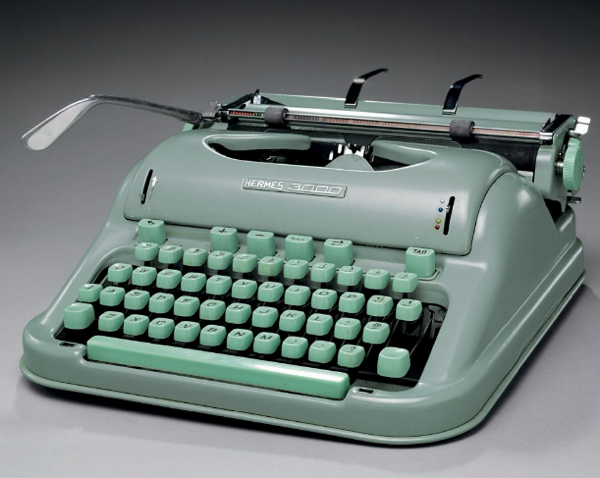
Jack Kerouac's typewriter
Jack Kerouac’s typewriter

1. A way to write things down

Whether it’s using a word processor, notebook with (many!) pens and (sharpened!) pencils, or a typewriter, the point of writing is to… umm… write things down. So you need a way to do this.

2. Ample light

Take care of your eyes and your sanity by writing in a well-lit location.

3. An inspirational statement posted somewhere you can see
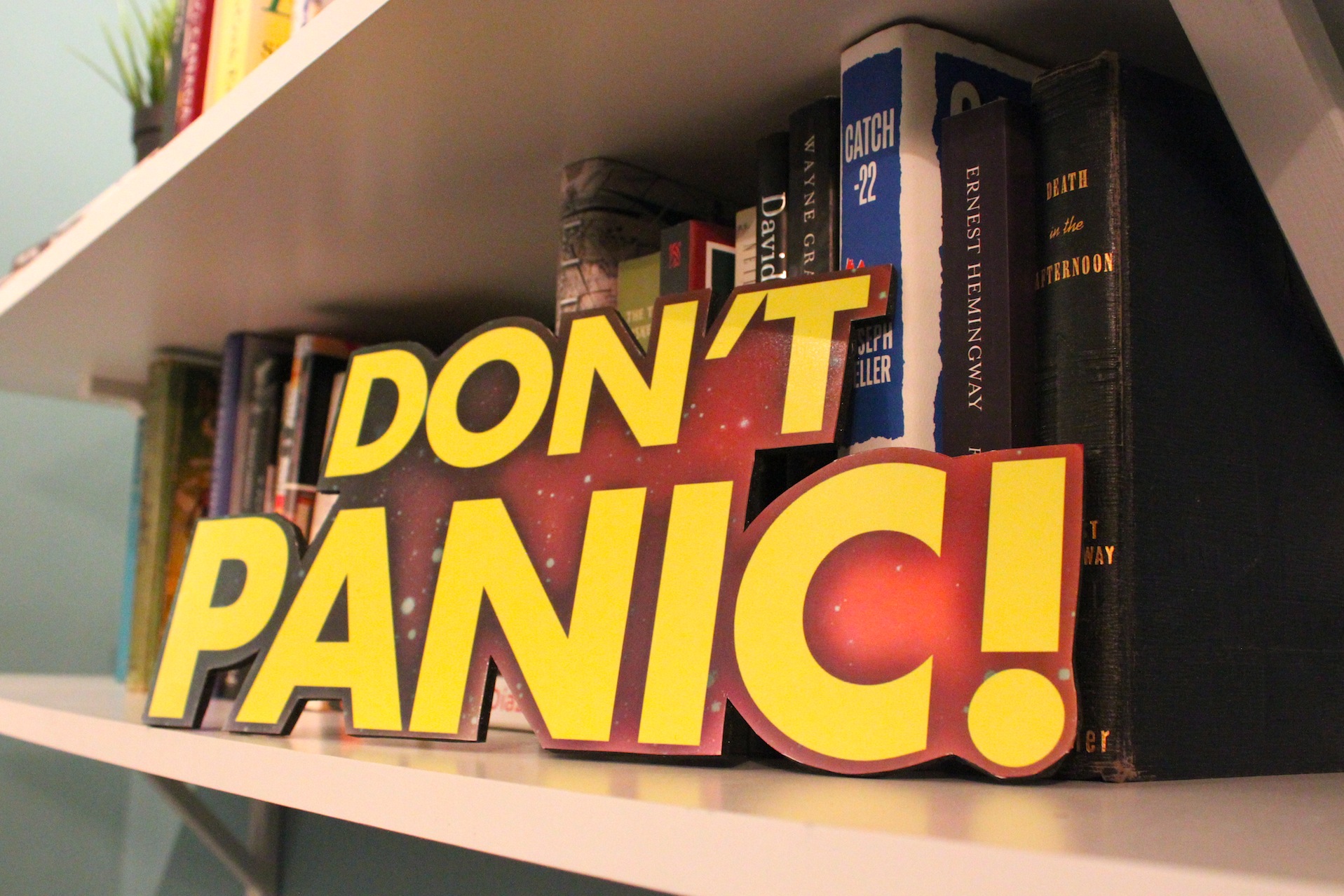
Don't panic - on my office bookshelf.

“Don’t panic!” – on my office bookshelf.

Here’s mine. Those of you who have read Hitchhiker’s Guide to the Galaxy will recognize the reference, but this particular sign has more meaning. I took this from the independent bookstore I worked at… on the last day it was open before it closed and we all got laid off. It’s too bad that the internet gobbled up the majority of inksplAt, my former blog, because it held a lot of the memories of my (wonderful, precious, special, amazing) time as a bookseller. Excuse me for a moment as I go sob in to my pillow…

4. A collection of writing prompts

Don’t let “writer’s block” be an excuse. Forestall it by finding a site with writing prompts (Poets & Writers – The Time is Now, Writing Prompts That Don’t Suck, etc.). Or create your own writing prompts. Write out a bunch of scenarios like: “and then a zombie walked in” or “he was craving Kool-Aid in a way he hadn’t since the day of the” or “and then he died.” The point of this exercise is not to necessarily write something that makes sense, but rather to just get you writing about anything until you can re-focus on your original storyline.

5. A bottle of water

I’m willing to bet you don’t drink enough. Water is essential for life, including optimal brain function. Plus it will make you feel fuller to cut down on the inevitable snacking.

6. Food made of food

As tempting as it is to fuel your writing binges with absolute junk, keep food on hand that has actual nutritional value.

7. Music (or silence)

If you are the type of writer who requires a soundtrack, make sure your playlist is ready to roll and your music device is fully charged. Personally, I write better in silence, but I do like to have a peppy song or two on hand to cheer me up if I’m having a rough writing day. If I need to switch it up, I like the Songza playlist “Conversation Pieces” for some weird mood music.

8. A clock with an alarm

Useful for a number of reasons including writing challenges (1k30min anyone?) and reminders to eat, shower, sleep, and just get up for a bit.

9. Proper posture

Future you will be thankful if current you can take five minutes to read this wikiHow article about how to sit at a computer (it has pictures!).

10. A good book

For inspiration, writing prompts, a brain break, or the comfort of nesting in a space, a good book should be a constant writing companion.

Did I miss anything that is essential in your toolkit? Let me know!

S.E. Lund

How to win Olympic gold in literature… metaphorically.

Did you watch the 2014 Winter Olympic Games in Sochi? I’m a big fan of the Olympics overall, but the Winter Games holds a special place in my heart because, well, I’m Canadian, and Canadians are good with winter. Also, there are so many weird and impressive sports in the Winter Games that I don’t get to see in the three intervening years (I mean ski cross? Snowboard slopestyle? This shit is crazy). I bring this up not to brag about Canada’s hockey and curling and moguls dominance – because that would be rude… and I’d hate to upset the stereotype of the mild-mannered, polite, and dull Canadian – but instead to talk about inspiration and goal setting.

It’s amazing to see ordinary people push themselves to their physical and mental limits to be the best in the world. It makes me feel hopeful. It makes me feel patriotic. It makes me feel inspired. But most of all, it makes me feel lazy. These athletes are working every day for years to be their best, and then testing their best against their peers. They work with coaches and trainers and teammates to make almost imperceptible changes and tiny improvements to their process/program/form/mental strength. They set challenging goals and allow themselves no excuses. So let’s do the same.

If you’ve ever worked in a corporate environment, you’ll be familiar with this process. Your ability to make and achieve professional goals is likely what determines if you receive a raise. Goal setting in your personal life is way more fun. My favourite goal setting resource actually comes from lululemon. Allow me to liberally copy-paste from their corporate blog right now:

break it down
Break your big goal down into multiple smaller goals. For example: if your goal is to do a handstand without the wall, set a goal that you can achieve in a shorter amount of time that will help you get there, such as “I will practice kicking up into handstand 20 times a week for a month by June 2011.”

write it in present tense
Write your goals in the present tense, as though they already happened. This gets your mind used to thinking that your dreams don’t have to be dreams; they can be reality.
Examples:
Asavakrasana is part of my yoga practice by November 2013.
I do a handstand without the wall and can hold it for 2 minutes by August 2012.

make it measureable
Can you measure your goal? If you can’t measure it, it’s not a goal. This can be a challenging part of goal-setting, but there is a way to write each of your biggest, baddest goals so that they are measurable in some way.

use affirmative language
Say what you will do, not what you won’t do. This will focus your energy on the desired outcome rather than the actions or behaviours that must stop.
Example: “I practice sidecrow” instead of “I stop avoiding sidecrow.”

be specific
Make your goals as specific and concise as possible. Keep it under 15 words, with no justification required. You can always change your mind!

by when
Attach a date to your goal. State the month in addition to the year. Dates keep you accountable. Don’t over-think things too much – just pick a date.

and now, your turn!
Here is a goal sheet for you to write in your 1, 5, and 10-year goals. At the top, write what your age and life will be like in 10 years.”

Perhaps I’ll post mine to stay accountable. It will not include the word “sidecrow.”

S.E. Lund

Self-indulgent crap: Or, how not to be Dawson Leery.

Netflix has the entire series of Dawson’s Creek available currently, and I’m not ashamed to say that I watched it all. I actually started it during NaNoWriMo on the second day of my flu, when the Dawson-Joey-Pacey love triangle was the most complicated thing my sickly neurons could process.

Aside from reminding me that Joshua Jackson’s Pacey is really the star of the show (sorry James Van Der Beek… Dawson is just incredibly unlikable for the first couple seasons, and by the time he grows up, we viewers can’t ever forget his whiny, wide-eyed childishness), Dawson’s Creek teaches budding creative types that their lives are super interesting – as a primetime soap opera. If you’re unfamiliar with the show, allow me to say *SPOILER ALERT* now, and you can decide to skip ahead a couple of paragraphs if you like.

Dawson Leery, naïve wannabe film director, makes a film in the second season to try to imbue his (first? second?) breakup with Joey with meaning. In the final season, he looks back on this attempt and calls it, if I can paraphrase, a self-indulgent piece of crap and waste of money. Then for some reason (mostly because people keep telling him he used to have “heart”) he does it again, sells it as a T.V. show that is exactly the same as Dawson’s Creek – because meta – and it leads to fame and fortune since teenagers acting out tiresome melodramas and deciding over years whether or not to have sex with one another has the “heart” everyone’s been looking for.

Maybe the average person’s life is interesting enough that others will enjoy experiencing it as second-hand fiction. But personally? If I can’t write an amazing story about my first year of high school, then I won’t be able to write an amazing story about “Jamie”’s first year at my high school either (She’s not me! Really! Look! She’s a red-head!).

I’m not saying that characters, settings, and themes need to be completely original to a writer (as we know, there’s nothing new in storytelling). Of course we’re going to pull from our own experiences, relationships, and personal feelings.

I am saying that if your story is simply your clone acting out the exact situations you went through, but it wouldn’t stand up as literary non-fiction, it’s probably self-indulgent crap. It’s fantasy mixed with nostalgia, and it may very well sell as a primetime soap opera to the CW, but it won’t help you grow as a writer.

A caveat or two to my argument: Maybe your story is interesting enough to stand on its own as literary non-fiction, but you want to frame it as fiction for some reason. That’s cool. More power to you. Maybe your purpose is not to grow as a writer necessarily, but to understand yourself as a person. I’m sure exploring yourself as a fictional character could have some psychological merit.

When I’m tempted to write a protagonist that is a not-too-veiled version of me, instead I write a fringe character who is definitely me. For example, I’m writing a young adult short story right now and I began molding “Aly” into a glorified fourteen year old me. So I introduced her parents. I tried to imagine what I would be like at forty, with a teenage daughter, and in the world of the story. This exercise makes me develop a creative version of myself (instead of a version blurred by wistfulness), and forces me to make my actual protagonist distinct from the “me” in the story. Much more interesting.

Accountability and the art of going it alone

When I first moved in with JT, he suffered an adjustment of perception. We had been together for years, and it had been firmly established that of the two of us, I was social and talkative, and he was quiet and introverted. After we became “housemates,”  he was forced to become acquainted with a side of me rarely experienced before.

Here’s the deal, reader. I like being quiet. I like being alone. In my spare time, I gravitate to activities that allow me the freedom to embrace those states of being: reading, running, painting, baking, Netflix binges and, of course, writing. I love working at a task – or indulging in a less goal-oriented activity – solo, in my own time, free of judgement and the expectations of others.

Don’t misunderstand, I’m also on a competitive sports team and several committees. I can play nice with others, and I really am social. However, it’s nice to create or complete or achieve or experience something purely for myself, without it being coloured by the influence or opinions of others. That is, it’s nice to create or complete or achieve or experience something purely for myself… when my will is fully charged, when I’m full of excitement and inspiration and creativity, when everything is going right.

The question is, when everything is going wrong, how do you stay accountable to yourself?

There are roughly a zillion articles, books, life coaches, and talk show special guests touting their mantras on persistence and visualization, trying to answer that question for us all. Maybe one or many of them have a foolproof way to make me more driven, focused, and self-motivated. If so, I haven’t come across it.

I struggle with follow-through in writing. I’m strong at the beginning, but when the thrill of newness wears away I’m guilty of abandoning stories and characters to the permanent limbo of a computer folder to grow old but never to maturity. Poor stories. Poor characters.

So how have I learned to stay accountable?

#1: I get honest with myself. Why do I want to write whatever I’m writing? For accolades? To enter in a contest? For a friend’s birthday present? To become rich and famous? Because I’m genuinely interested in where the story is going? I don’t think that any of these reasons are bad (unrealistic or shallow, maybe, but not bad), but some have more value than others. I’ve found the amount of effort I put into a project is directly proportional to the reason I’m doing it. If the reason is less valuable, then I need to find another reason (as simple as “if I finish a first draft of this story, I’m buying brand-name groceries next week” or as significant as “Finishing a first draft of this story could be the most important thing I do for this entire year, and if I fail, it will be indicative of everything I attempt in 2014”).

#2: I give myself a break. Some people work well with a scheduled writing time or set number of words every day. But some people don’t. My relationship with structure is complicated. I enjoy rules. I find they not only give me something to work within, but also through and around. NaNoWriMo taught me that structure (1700 words a day or else) certainly can have positive results in my writing. But come December I took a break. I turned off the laptop and ignored my draft for a couple of weeks. When I felt like writing again, I did it for the pleasure of it, for the creativity, and with the happy looseness of freedom from the taskmaster of my NaNoWriMo contract. I’ve discovered that writing on a strict schedule is beneficial for me only if I can see an end point. Otherwise, it saps the joy.

#3: I get social. In the end, sometimes it’s not enough for me  to be accountable only to myself. When I was in a writing group, they expected me to show up with new material every week. If I tell my parents and sister, teammates, or best friends about something I’m writing, they immediately ask when it will be done, and when they can read it. This keeps me going sometimes when I need a kick in the ass that self-bribery, threats, or white-knuckle will power just isn’t providing. (JT isn’t good at this, and I’m thankful for it. Sometimes I need someone who will just blindly support me in whatever choice I make… even if it’s quitting.)

Will my rules be a foolproof solution for your own struggles? Probably not. They only work for me about two-thirds of the time. But maybe the main theme of each (honesty, joy, support) can be customized to fit your needs.

Much love,

S.E. Lund